
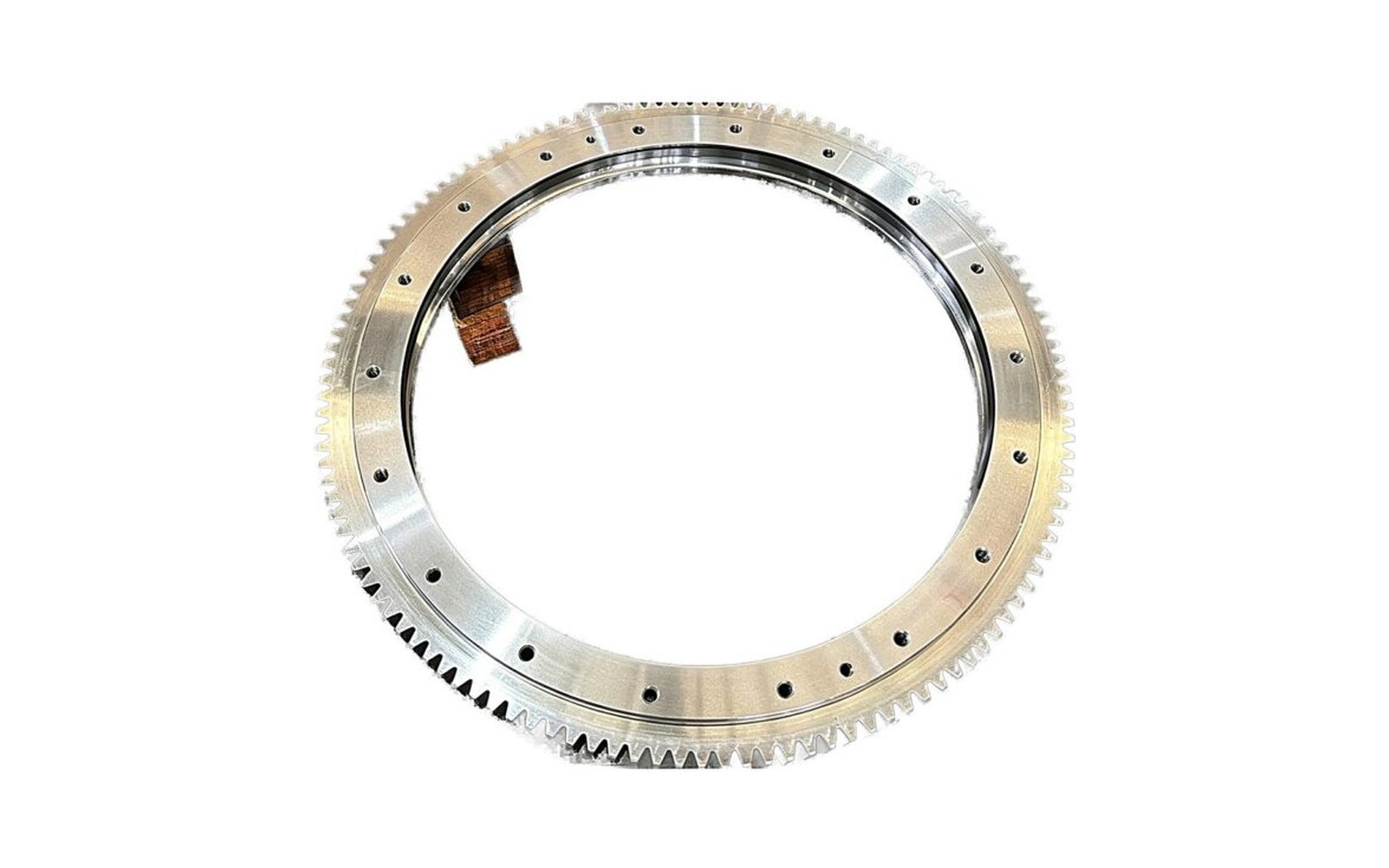
What is a three-row roller slewing bearing?
A three-row roller slewing bearing is a slewing ring built with three separate raceways: an upper axial row, a lower axial row and a vertical radial row. Each raceway has its own set of cylindrical rollers, and each is loaded only in the direction it was designed for.
That separation is the whole idea. In a single-raceway ball ring, one contact has to resolve axial load, radial load and tilting moment together, so the ball size and the raceway geometry are a compromise. Splitting the load paths lets each row be optimised, and the capacity that comes out of the same diameter is far higher.
In our range the structure runs from 500 mm to 6,000 mm outside diameter, with section heights of 106 mm to 300 mm — the tallest structure we make, and the one we propose as standard above about two metres.
Types of three-row roller slewing bearing
The three rows are stacked, not mixed. The upper and lower axial rows take axial load in both directions and, because they sit at a distance from each other, the tilting moment as a couple. The vertical row takes radial load only.
| Variant | Gear | Typical machine |
|---|---|---|
| External gear three-row roller | Teeth on the outer diameter, module 6–25 | Stacker-reclaimers, deck cranes, large turntables |
| Internal gear three-row roller | Teeth in the bore | Excavators and machines where the mesh must be protected |
Gearing is a machining operation on top of the structure, not a separate family. All three variants share the same raceway arrangement, the same hardening and the same sealing options.
Features of a three-row roller slewing bearing
- Highest capacity per unit of diameter in the range. Static axial rating to 12,000 kN, radial to 3,000 kN, tilting moment to 5,000 kNm.
- Load paths kept apart. Each row is loaded in one direction, so the rollers and the raceway geometry are sized for that direction rather than for a compromise.
- Induction hardened raceways with the soft zone marked and positioned away from the loaded arc.
- Gear to module 25, induction hardened to 50–58 HRC on the teeth, available externally or internally.
- Double-lip NBR seals as standard, Viton on request for hot or aggressive environments.
- Split ring option for structures that cannot be threaded over a shaft.
Applications of three-row roller bearings
Three-row roller rings turn up wherever the load is heavy and continuous rather than occasional: bulk-handling terminals head the list, closely followed by deck cranes and ladle turrets.
| Machine | Why this structure |
|---|---|
| Deck cranes and quay cranes | Heavy axial load combined with a long moment arm |
| Ladle turrets and converter rings | High load at temperature, with thermal growth designed in |
| Large excavators and mining shovels | Shock load plus an eccentric working radius |
| Wind turbine yaw systems (large frames) | Moment-dominated load with a long service life |
Below two metres the three-row structure is often more capacity than the machine needs, and a four-point contact or double row ball ring does the same job in less height and at lower cost.
Working principle of a three-row roller bearing
Load enters through the bolt circle of one ring and leaves through the bolt circle of the other. Between them, the rollers distribute it across the three raceways.
An axial load pushes the upper ring down. The upper axial row takes the load in one direction; reverse the load and the lower row takes it. A tilting moment loads the upper row on one side and the lower row on the opposite side — the two rows form a couple whose lever arm is the distance between them, which is why the tall section is an advantage rather than a compromise. A radial load goes into the vertical row, whose rollers run on a cylindrical path at the outside diameter of the inner ring.
Rotation comes from either the gear, when fitted, or a separate drive. The cage or spacer keeps the rollers evenly spaced around the perimeter so the load is shared rather than concentrated at the point where the load enters.
How does a three-row roller bearing work in a machine?
The ring bolts to a machined flange at top and bottom. Flatness and bolt preload matter more here than on a ball ring, because a three-row ring is stiff enough that it will not absorb a badly machined flange — the flange will deflect the ring instead, and the load will concentrate on part of the raceway.
Because the section is tall, the ring also takes up vertical space in the design. That is the trade: the capacity is bought with height, and a machine that is height-limited cannot use it, however attractive the load rating looks on paper.
Load capacity
The three ratings are quoted separately because they are governed by different failure modes.
| Rating | Figure in this range | What it governs |
|---|---|---|
| Static radial | to 3,000 kN | Radial row deformation under side load |
| Static tilting moment | to 5,000 kNm | The couple across the two axial rows; usually the figure that decides the size |
For continuously rotating equipment the static ratings are only a starting point. Above a few hundred thousand load cycles per year the ring has to be sized on the fatigue life of the raceway, which depends on the load spectrum and the hardened depth rather than on the catalogue figures.
Three-row roller slewing bearing for sale
Rings are quoted per drawing or per load case. Send the outside diameter, raceway centre diameter, section height, hole pattern, gear module and the three load figures; if the machine already exists, send the old part number and we will reverse-engineer the drawing.
Standard sizes are held for the common diameters, with larger and non-standard rings machined to order.
Three-row roller bearing buying guide
1. Check that the structure is right before the size. If the load is moment-dominated and the machine has height to spare, three-row roller is the answer; if not, a ball ring in less height may be better. 2. Size on the moment. The axial rating looks impressive and is rarely the binding constraint. 3. Ask for the hardened depth with the hardness figure. Hardness without depth does not tell you whether the raceway will survive the load cycles. 4. Decide internal or external gear early. It changes the pinion position, the guard and the service access. 5. Check mounting flatness and bolt class. A stiff ring will not forgive a soft flange. 6. Consider a split ring if the structure cannot be dismantled to fit a one-piece ring over a shaft.
Three-row roller slewing bearing customization
Non-standard bolt patterns, split rings, special grease channel positions, tapped holes in the flange face, alternative seal materials, phosphate or painted finish, and gear teeth cut to a mating pinion sample are all machined to order. Rings can also be supplied with the soft zone positioned to a specified angle when the loaded arc is known.
Three-row roller slewing bearing packaging and shipping
Three-row roller rings above about 1.2 m ship upright in a plywood case with the raceway face protected and lifting points marked. The case carries the inspection record with measured hardness, hardened depth, clearance and gear backlash, plus the grease specification.
Large rings are lifted with a spreader beam, never with a sling through the bore, and the packing is photographed before the case is closed.
Three-row roller slewing bearing manufacturer
Three-row roller rings are machined, induction hardened, ground and assembled in one plant, which is what allows the hardened depth and the clearance to be quoted with a batch reference attached.
The range covers 500 mm to 6,000 mm outside diameter, section heights of 106 mm to 300 mm, gearing to module 25 both internal and external, and a static capacity to 12,000 kN axial.
FAQ of three-row roller slewing bearing
Where can I buy a three-row roller slewing bearing?
Rings are quoted per drawing or per load case, either as a standard diameter from stock or machined to order. Send the outside diameter, section height, gear module and the three load figures and the quotation comes back with the structure confirmed.
When should I choose three-row roller over four-point contact?
When the load is heavy and sustained, or when the moment is large enough that a ball ring would need a diameter the machine cannot accommodate. If height is the binding constraint, stay with the ball structure.
Can the rows be re-lubricated separately?
Yes. Grease channels are positioned per row, and on large rings we specify the nipple positions so each row can be reached without dismantling the machine.
What is the soft zone on a three-row roller ring and why does it matter?
It is the unhardened strip left where the filling plug and the hardening inductor start and stop. It is positioned away from the loaded arc; if a ring is fitted rotated, that strip can end up in the load path.
Is a split three-row roller ring as strong as a one-piece ring?
The split is bolted and pinned across the section, so capacity is close but not identical. It is used where the structure cannot be threaded over a shaft, not as a default.
What lead time should I plan for?
Standard diameters four to six weeks; above 3 m and for split rings, eight to ten weeks including the inspection record.
Send the three load figures and the mounting space, and we will confirm whether a three-row roller ring is the right structure.
Send your load case