
Slewing bearings
Slewing bearings for axial, radial and tilting-moment load
A slewing ring lets a structure rotate while carrying load in three directions at once. Seven structures, geared or plain, machined to your drawing with the hardening, clearance and sealing the application needs.
Tell us the load and the rotation. We come back with a size and a price within one working day.
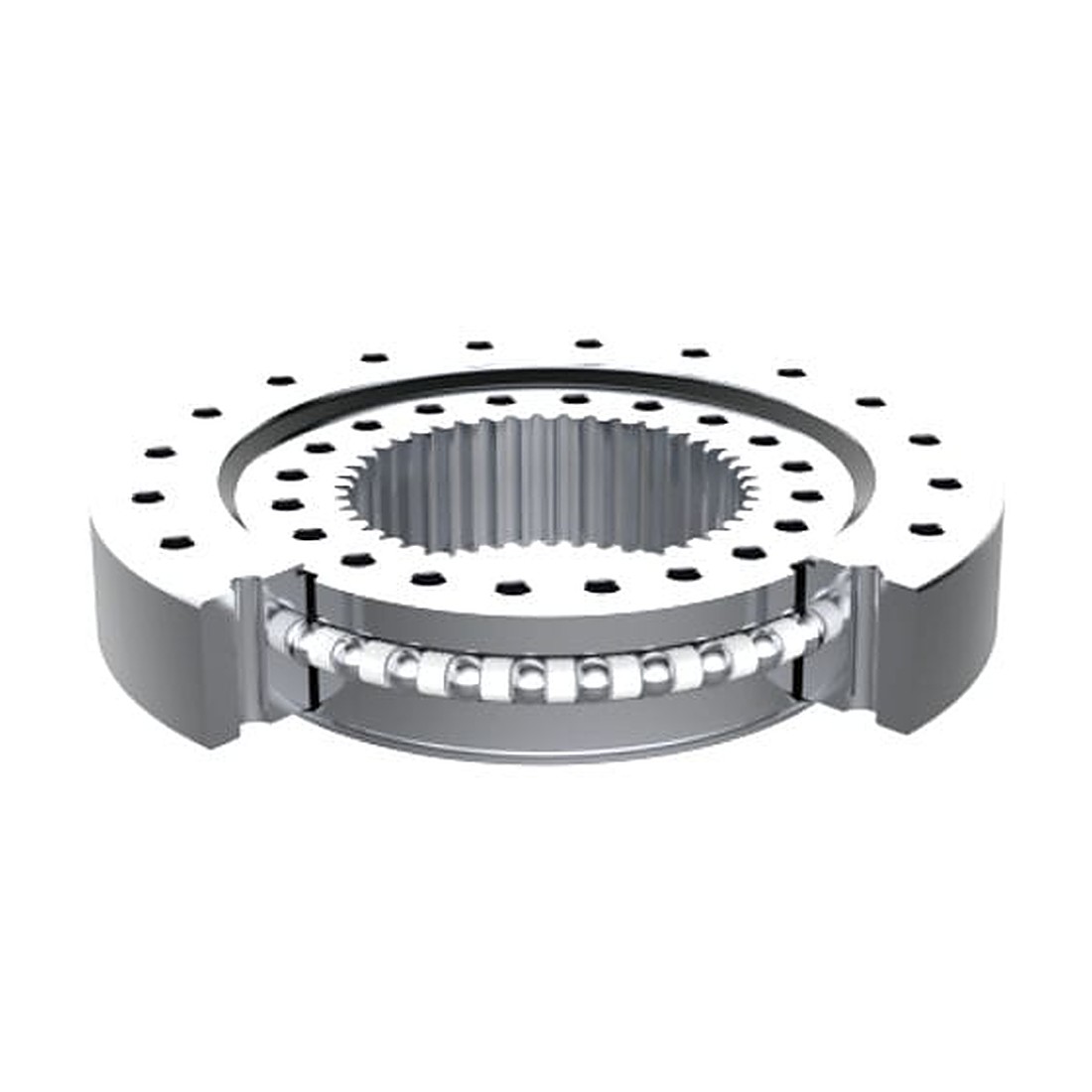
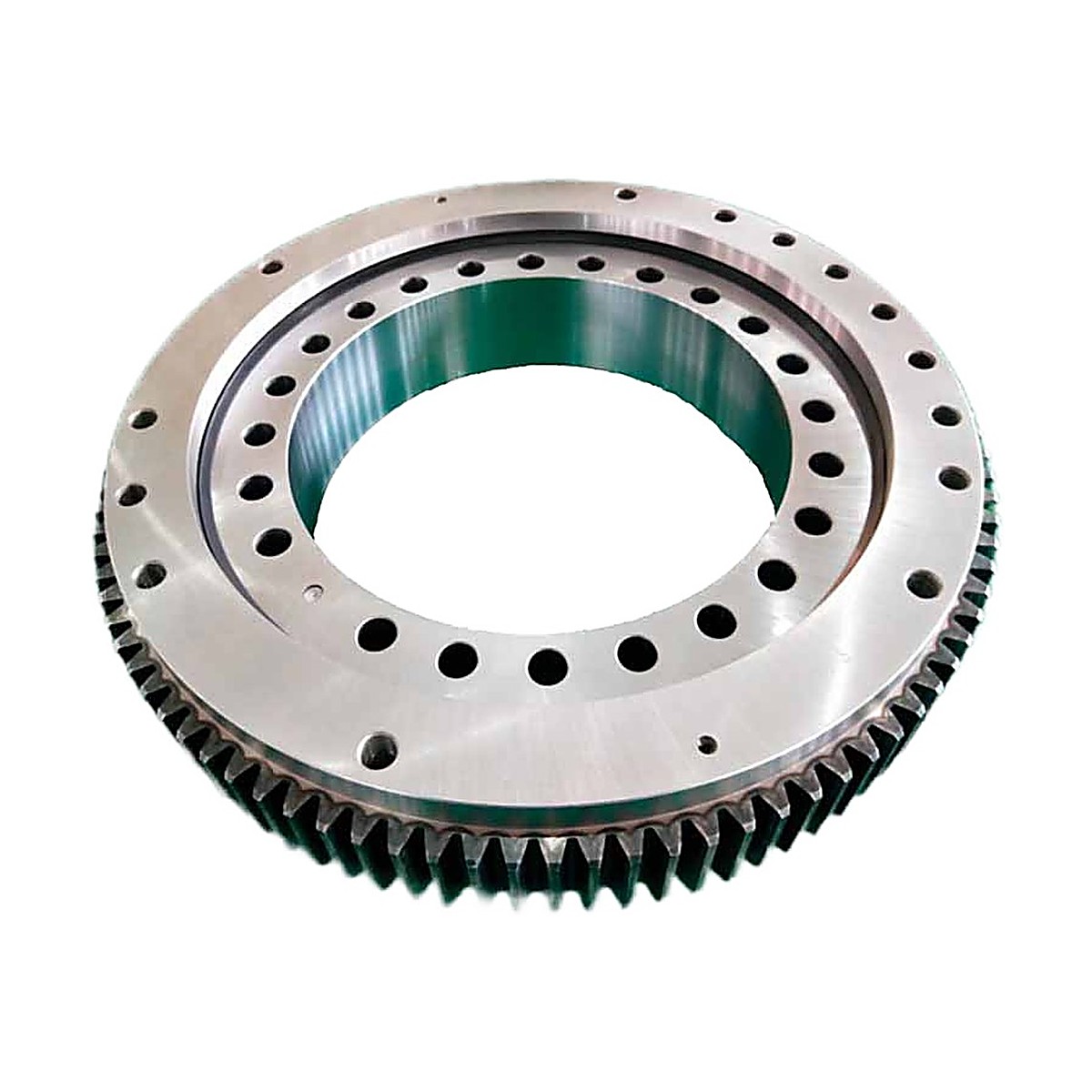
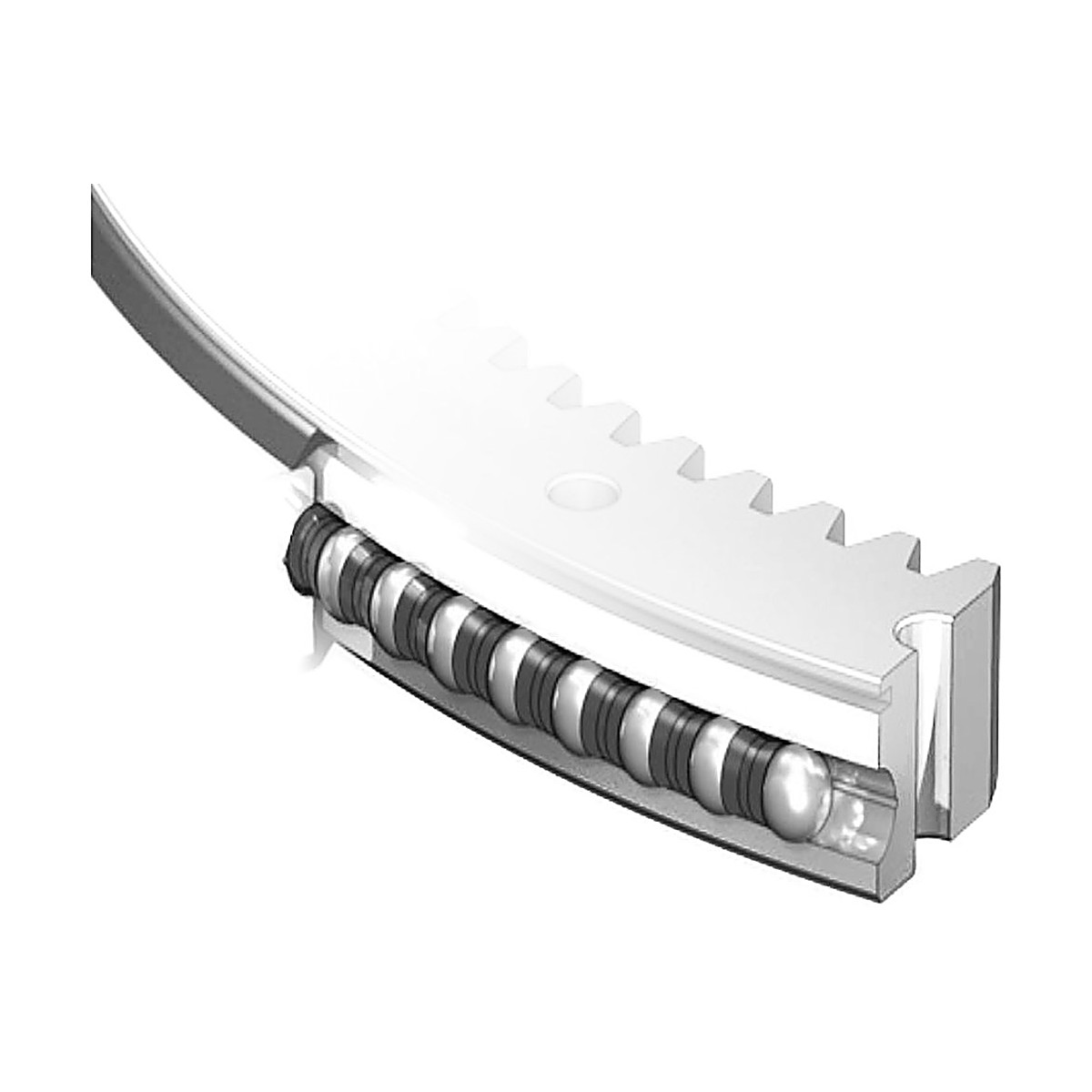
Four-point contact ball ring, 011 series — one raceway takes axial, radial and moment load at once.
- Raceway 42CrMo4, induction hardened 55–58 HRC
- Clearance and preload set to your drawing
- Labyrinth, lip or double-lip seal
Structures
Seven bearing structures in our range
Four-Point Contact Ball
011
One raceway carries axial, radial and moment load. Compact section height.
What you can specify
Geometry
- Outside and bore diameter
- Raceway centre diameter
- Section height
- Mounting hole pattern and counterbore
- Grease nipple and plug position
- Split ring for closed structures
Material & heat treatment
- 42CrMo4 or 50Mn ring blanks
- Induction hardened raceway
- Hardness checked per batch
- Soft zone marked for the filling plug
- Phosphating or painting
Running behaviour
- Axial and radial clearance grade
- Gear backlash tolerance
- Starting and running torque limits
- Double-lip NBR seals
- Greased for life or re-lubricated
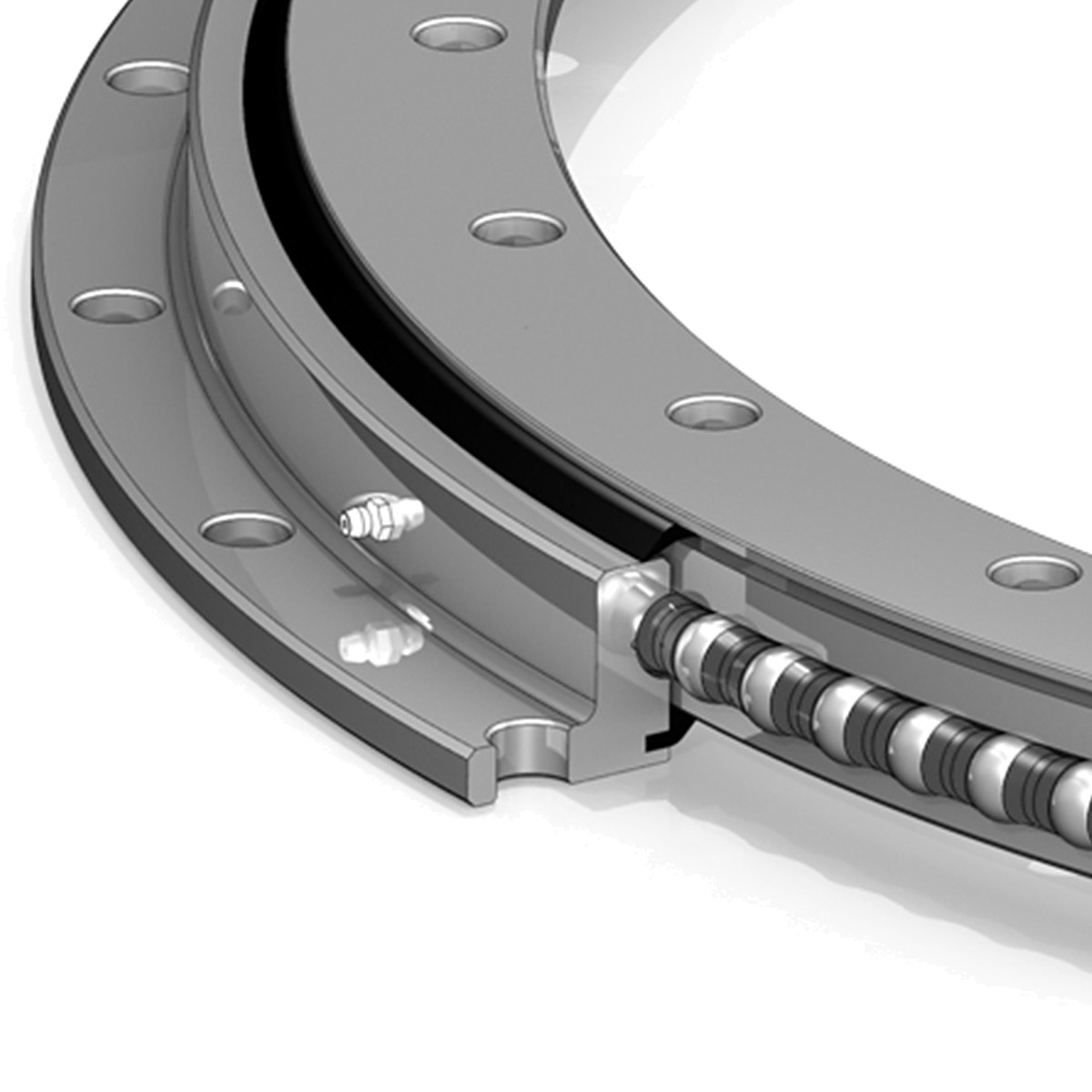
Seal and raceway
The detail that decides service life
Two things fail before the steel does: the seal lets water in, and the raceway loses its hardened layer. We quote both explicitly — seal type and material, and the hardened depth and hardness range with the inspection record that proves it.
- Double-lip NBR as standard, Viton for high temperature
- Raceway hardness recorded per batch with the heat number
- Soft zone positioned away from the loaded arc
Slewing bearing guide
Everything a design or maintenance engineer asks before specifying a slewing ring: what the part does, which structure fits the load, how to size it, and how it is built, packed and shipped.
What is a slewing bearing?
A slewing bearing — also sold as a slewing ring, turntable bearing or swing bearing — is a large-diameter rolling bearing that lets two parts of a machine rotate against each other while carrying load in three directions at once: axial load, radial load and tilting moment.
What separates it from an ordinary bearing is proportion. The raceway sits close to the outside diameter of the part, so the bearing is not an insert inside a housing — it is the joint. Machine frames bolt directly to the inner and outer rings, and the same part often carries gear teeth, mounting holes, seals and grease ports.
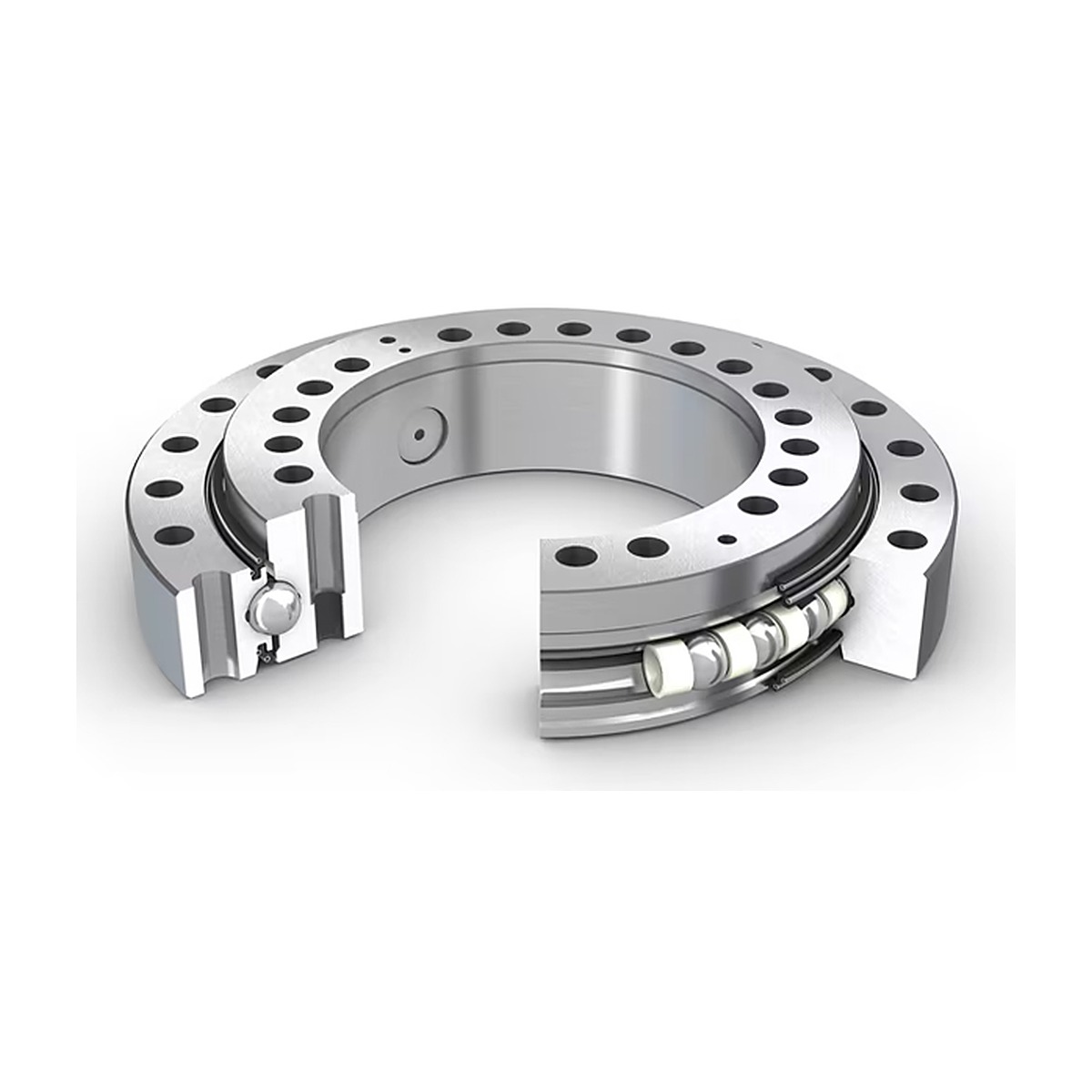
A typical unit contains an inner ring, an outer ring, one or two rows of balls or rollers, a cage or spacer, two seals and one or two grease nipples. Where the application needs powered rotation, the ring is cut with gear teeth, or the complete bearing is built into a slew drive.
Types of slewing bearings
Eight structures cover most of the machines built today. The choice is set by the load case and the available section height, not by preference.
- Four-point contact ball — one raceway, four contact points. Carries axial load in both directions, radial load and moment in the most compact section available.
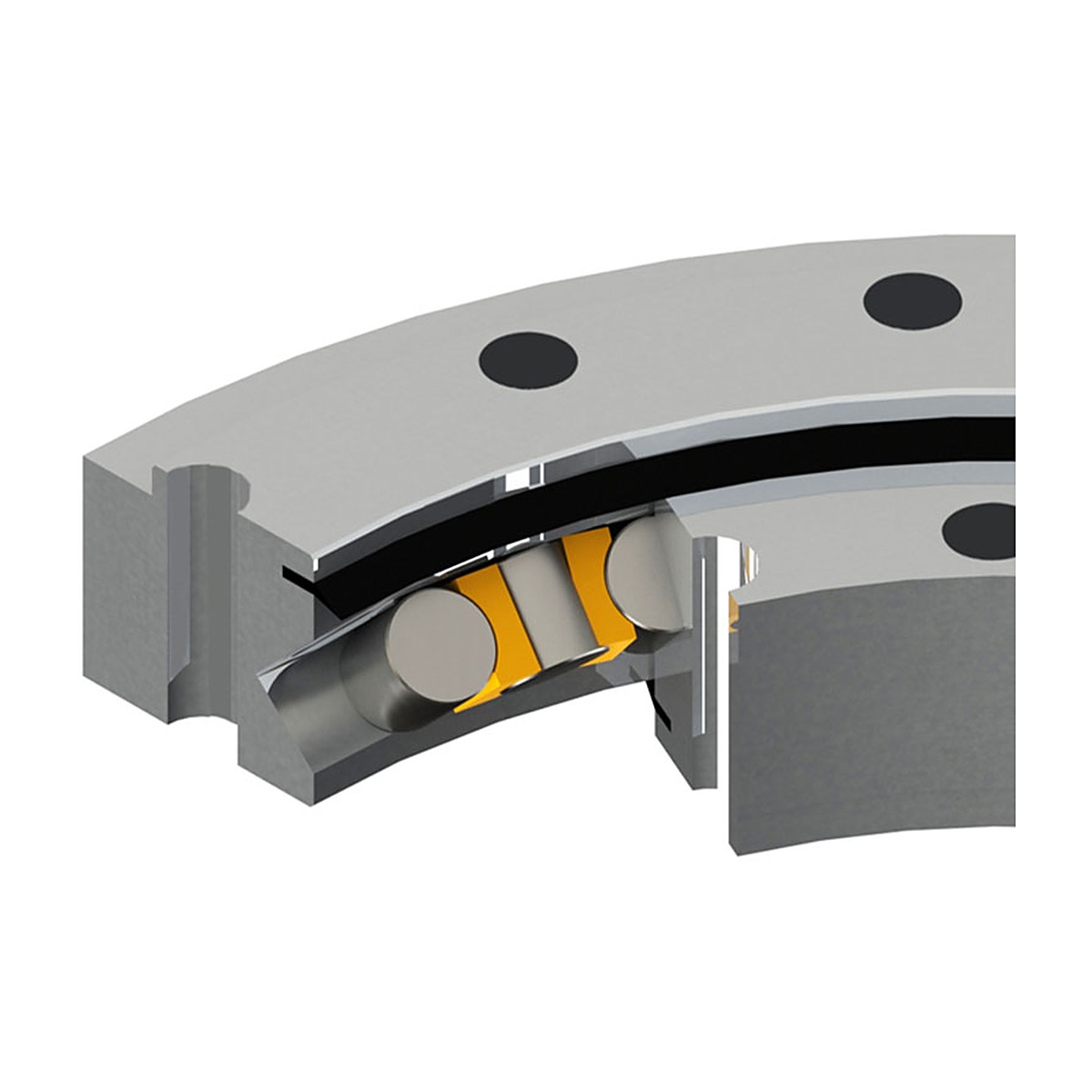
- Crossed roller — cylindrical rollers set at 90° to each other. The stiffest option: deflection under combined load is the lowest of any structure here.
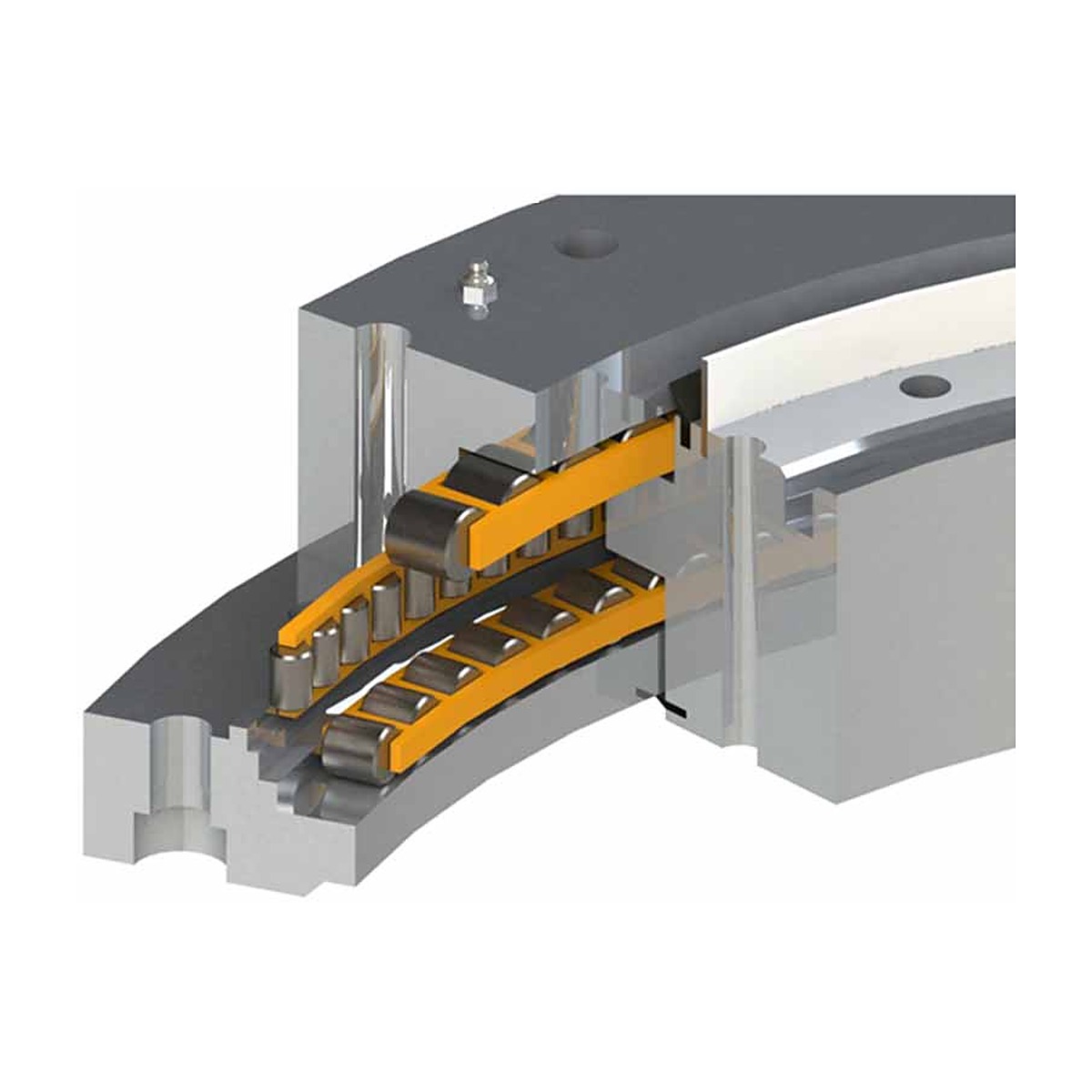
- Three-row roller — separate axial and radial raceways. The highest load capacity, at the cost of a taller section.
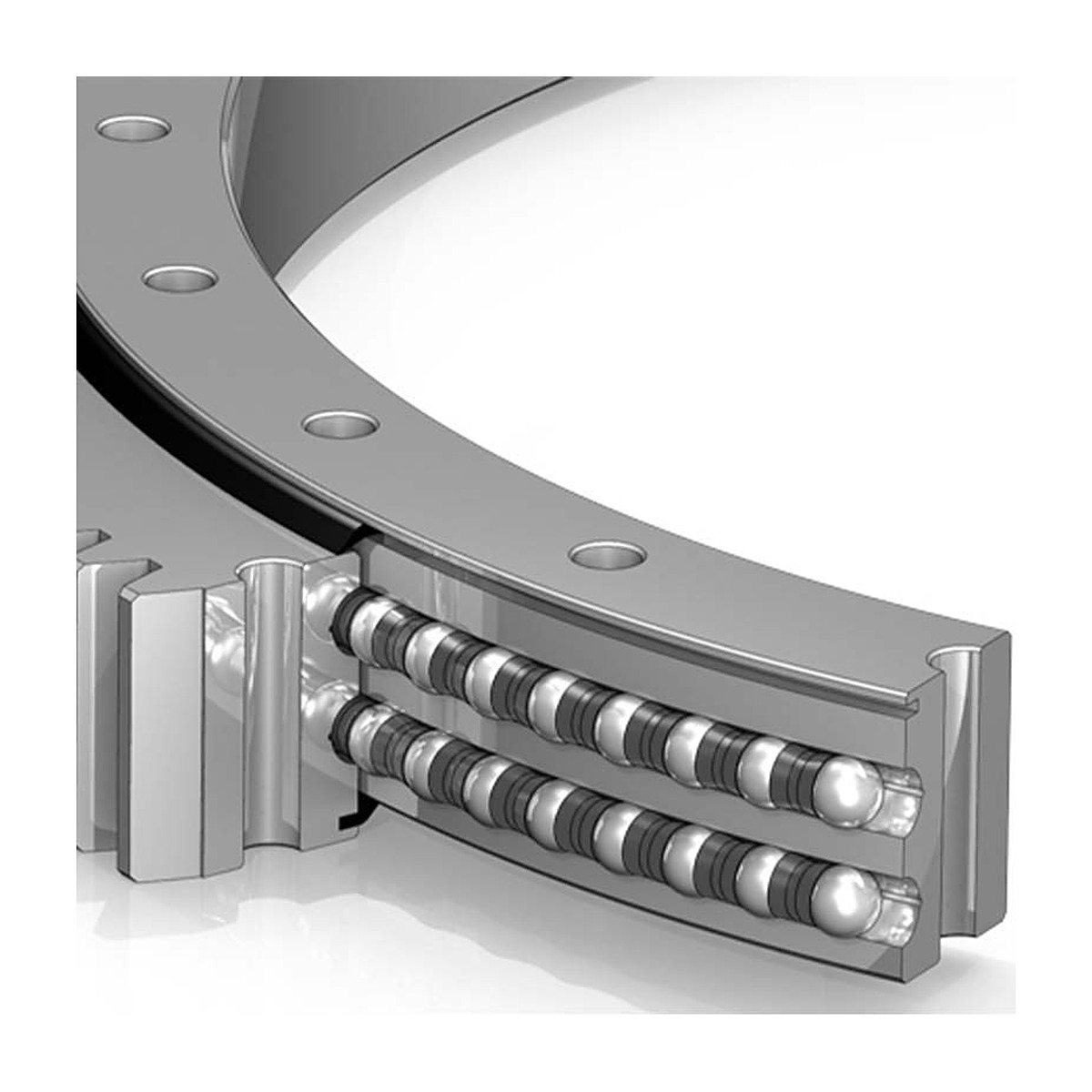
- Double-row ball — two rows of balls, with an eight-point contact option that lifts tilting capacity above a single-row ring at a similar height.
- External gear — teeth on the outer ring, driven by a pinion outside the frame.
- Internal gear — teeth on the inner ring, so the pinion sits inside the structure and is protected from impact.
- Flanged — an integral flange replaces the adapter plate: the ring bolts straight onto the frame and the stack height drops.
- Light series — thin section, low weight, free rotation. For turntables, displays and positioning equipment where load is moderate.
Gear teeth are a separate decision from structure. Any of the eight can be supplied ungeared, with external teeth or with internal teeth, in the same envelope.
Features of slewing bearings
- Three load directions in one part — axial, radial and tilting moment share the same rolling elements, which removes the separate thrust bearing, radial bearing and housing a conventional design would need.
- Large bore, thin section — the machine’s shaft, cable run or hydraulic line passes through the centre of the ring.
- Integrated gear teeth — external or internal, induction hardened, cut to the module and tooth count your pinion expects.
- Induction hardened raceway — 42CrMo4 or 50Mn ring blanks, hardened to a controlled depth, with the hardness and heat number recorded per batch.
- Controlled clearance — axial and radial clearance grade, gear backlash tolerance and starting torque limits are all quoted, not left to a general standard.
- Double-lip NBR seals as standard — Viton for high-temperature or aggressive environments, with the seal type stated on the drawing.
- Greased for life or re-lubricated — nipple and plug positions set to your access requirements, with a soft zone marked on the raceway.
- Split ring option — for structures that cannot be lifted over a shaft during assembly or replacement.
Applications of slewing bearings
- Solar trackers — single-axis trackers use the ring as the rotation joint for the torque tube; slow motion, high moment, and decades of exposure to weather.
- Construction machinery — excavators, mini excavators and loader cranes swing on a ring that takes shock load and debris daily.
- Port and marine equipment — ship loaders, harbour cranes and deck machinery, where salt spray decides seal and coating specification.
- Mining and metallurgy — stacker-reclaimers, ladle turrets and continuous casters: high load, high temperature, continuous duty.
- Machine tools — rotary tables and indexing heads, where stiffness and repeatability matter more than raw capacity.
- Industrial automation and robotics — robot positioners, rotary assembly stations and pallet changers.
- Medical and display equipment — CT gantries, examination chairs, revolving stages and display turntables, usually on the light series.
- Material handling — stackers, transfer carriages and rotating forks.
The pattern across all of them is the same: a large open centre, a slow rotation, and a load that would otherwise need three separate bearings and a heavy housing.
Slewing bearings for sale
No catalogue number covers every machine. The common structures and reference sizes are held ready for quotation, and everything else is cut to your drawing — which is the normal case, not the exception.
Price is driven by ring outside diameter, structure, whether the ring is geared, hardening depth, seal material, the inspection level you ask for, and quantity. Two rings of the same diameter can differ by a wide margin for those reasons alone, which is why a quotation is built from the drawing rather than from a size list.
Minimum order. One piece is accepted for a prototype, a replacement or a trial fit. Batch pricing applies from the quantity where fixturing is already amortised.
Lead time. We state it in the quotation instead of on this page, because a 300 mm ring and a 3 m ring do not share a schedule, and a new forging is not the same job as machining an existing blank. The quotation always separates machining time from material lead time so you can see where the weeks go.
To start, send a drawing in PDF, DWG or STEP plus the quantity. If the drawing does not exist, send the old part number, the key dimensions and the load the ring carries.
Slewing bearing buying guide
Most quoting delays and most field failures trace back to the same missing information. Define these seven items before you ask for a price.
- The load case. Axial load, radial load and tilting moment, each with its magnitude and whether it is static, continuous or shock. A duty cycle with time percentages is worth more than a single peak figure.
- The structure. Fixed by load direction and stiffness requirement. If you need the shortest possible section at moderate load, that points to four-point contact; if deflection must be minimal, crossed roller.
- Rating and safety factor. The static and dynamic ratings must be compared against your load case with the safety factor your industry expects — not against the bearing’s maximum.
- The envelope. Outside diameter, bore, raceway centre diameter, section height, and the mounting hole pattern taken from the mating frame. The hole pattern is what makes a replacement fit or not fit.
- The gear data. If the ring is driven: module, number of teeth, pressure angle, backlash tolerance and the pinion that will run against it.
- Clearance and torque. Axial and radial clearance grade, plus the starting torque ceiling if the drive motor is small.
- The environment. Temperature range, water, dust, washdown chemicals and whether the ring is inaccessible for re-lubrication. This decides seal material, grease and coating.
One more item belongs to installation rather than to the bearing: the flatness, surface hardness and bolt grade of the mating structure. An over-flexible frame will distort a correct ring, and no inspection certificate can compensate for it.
Working principle of a slewing bearing
Load transfer happens through the rolling elements, and the geometry of the raceway decides which loads reach them.
In a four-point contact ring, each ball touches the raceway at four points. Axial load in either direction, radial load and tilting moment all pass through the same ball set, which is why the section can stay compact while still carrying three-direction load. In a crossed roller ring the rollers are arranged at 90°, so one raceway takes axial load and the other takes radial load, with very little elastic deflection between them. In a three-row roller ring the axial and radial raceways are physically separated, which is what allows the highest capacity of the three.
Tilting moment capacity rises roughly with the square of the raceway diameter, because both the number of loaded elements and their distance from the centre increase. Section height, however, grows only in proportion to diameter. That is the reason a large machine uses a thin large ring rather than a small heavy bearing: the moment arm does the work.
Where the ring is geared, torque enters through the teeth and leaves as rotation of one ring relative to the other. The gear does not change the load path inside the bearing — it only adds a tangential force at the pitch circle, which must be included in the load case.
How does a slewing bearing work?
In service the sequence is mechanical and short: the structure is bolted to both rings, one ring is held, the other is driven or left free, and the rolling elements carry whatever the machine puts through the joint. What decides whether it lasts is the installation and the maintenance around it.
- Mounting surface. Both mating faces must be flat and stiff enough that bolting does not bend the ring. A ring forced onto an uneven frame loses clearance on one side and loads a few elements instead of all of them.
- Bolt preload. Bolts are tightened in a cross pattern to the torque stated for the grade and size, and re-checked after the first operating hours. Under-torqued bolts let the ring move; over- torqued bolts yield.
- Lubrication. Grease is applied until it appears at the seal, then at the interval the application allows. A ring that cannot be reached for re-lubrication has to be greased for life, which changes the grease specification at the quotation stage.
- Rotation and load. Under rotation the loaded zone moves around the raceway, so every element sees load in turn. A ring that only oscillates over a few degrees develops a false brinelling pattern and needs a different hardening and grease strategy.
- Inspection. Clearance, seal condition, grease colour and gear backlash are the four checks that catch a problem before it becomes a replacement. Water in the grease shows as a colour change long before the raceway spalls.
Customize your slewing bearing
Almost every ring we ship is a variant. The list below is what can be changed without changing the structure, which keeps the tooling cost at zero for the common cases.
- Geometry — outside and bore diameter, raceway centre diameter, section height, mounting hole pattern, counterbore depth, grease nipple and plug position.
- Material and heat treatment — 42CrMo4 or 50Mn, induction hardened raceway with a stated depth and hardness range, phosphating or painting, soft zone positioned away from the loaded arc.
- Gear — module, tooth count, pressure angle, backlash band, external or internal teeth, hardened or soft.
- Interfaces — threaded holes, dowel holes, pilot diameters, tapped lifting points, encoder mounting pads.
- Sealing — double-lip NBR, Viton for high temperature, additional labyrinth or wiper where dust is heavy.
- Split design — split inner or outer ring with joint bolts, for closed structures.
- Testing and documentation — hardness report, clearance record, runout and torque measurement, material certificate, third-party inspection if you require it.
- Marking and packing — part number, heat number, orientation mark and customer label on the ring, with packing built around your receiving and lifting equipment.
Slewing bearing packaging & shipping
A hardened raceway is a finished surface from the moment it leaves grinding. Packing exists to keep it that way through a sea container and a warehouse.
- Surface protection — VCI film against condensation, desiccant in the sealed bag, and a rust-preventive coating on machined faces for long transit.
- Mechanical protection — the ring is blocked so it cannot slide, and the raceway faces are kept off the crate floor. Large rings are fixed to a wooden pallet with the faces vertical or protected by timber battens.
- Crate — plywood case or sea-worthy wooden crate, with the crate sized so the ring cannot move and the load is spread across the base, not concentrated on one point.
- Lifting — marked lifting points and a centre-of-gravity mark. Rings above a certain mass are supplied with lifting lugs or a stated slinging method.
- Documents — packing list, inspection report, material certificate and certificate of origin, inside a document pocket on the outside of the crate rather than loose in the box.
- Terms — EXW, FOB or CIF, sea freight LCL or FCL depending on volume, air freight where the schedule justifies the cost. Insurance is quoted on request.
Tell us the receiving conditions — outdoor storage, crane capacity, container type — and the packing is built around them instead of around a default.
Slewing bearing manufacturer
The reason to buy from the maker rather than from a trader is tolerance ownership. A ring is the sum of a forging, a turning operation, a heat treatment, a grinding operation and an assembly, and every one of those steps can move the clearance. When one supplier owns all of them, the clearance quoted is the clearance delivered.
The production route for a standard ring runs: ring rolling or forging → normalising → rough turning → gear cutting where geared → induction hardening of the raceway → finish grinding → assembly with cage, seals and grease → inspection → packing.
Inspection is where the claims are tested. Raceway hardness is measured and recorded with the heat number, clearance and runout are measured on the assembled ring, gear backlash is checked against the pinion data, and starting torque is measured where the drive is small. Those records travel with the shipment instead of staying in the factory.
What that changes for you: one contact for the drawing, one party responsible if the ring arrives outside the quoted clearance, and the ability to change a seal material or a hole pattern without negotiating with three tiers of supplier.
FAQ of slewing bearings
Is a slewing bearing the same as a turntable bearing?
Yes. Slewing bearing, slewing ring, turntable bearing, swing bearing and rotation bearing all describe the same product. The names come from different industries — construction tends to say swing bearing, machine tools say rotary table bearing, solar and material handling say slewing ring.
Can you supply a replacement for a bearing from another brand?
Yes. Send the part number, or if it is unreadable, the outside diameter, bore, section height, hole pattern and gear data. We rebuild the model, send it for your approval, and machine against the approved drawing so the replacement drops into the existing bolt pattern.
What information do you need to quote?
The load case (axial, radial and tilting moment), the envelope (diameters, section height, hole pattern), whether the ring is geared and the gear data, the environment, the quantity, and a drawing if one exists. A photo of the old part and its markings helps more than it sounds.
Do you make split bearings?
Yes, for structures that cannot be lifted over a shaft. The split is made through the ring with joint bolts and a matched joint face, and the clearance is checked after assembly rather than before.
How is the bearing lubricated in service?
Either greased for life with the seals fitted at assembly, or supplied with grease nipples and a marked soft zone for re-lubrication. The interval depends on the grease, the duty cycle and the environment — we state a starting interval in the documentation and adjust it once you have operating hours.
What is the minimum order quantity?
One piece, for a prototype, a single replacement or a trial fit. There is no batch threshold to cross before we will quote.
How is a large ring packed for sea freight?
VCI film and desiccant, blocked inside a sea-worthy wooden crate with the raceway faces protected, lifting points marked, and the inspection documents in a pocket on the outside of the crate.
Send your ring drawing
PDF, DWG or STEP plus the quantity. If it is a replacement, send the old part number or the key dimensions and we will rebuild the model for approval.