
Custom parts
Gear pairs, ring gears and bearings built to your drawing
Not every machine can use a catalogue ring. We reverse-engineer old parts, rebuild the model for approval, then machine the ring, the gear pair or the complete drive to that drawing.
Tell us the load and the rotation. We come back with a size and a price within one working day.
What we customise
Geometry
- Any outside diameter within our machining range
- Non-standard hole patterns
- Split rings for closed structures
- Custom flange and adapter plates
Gear parts
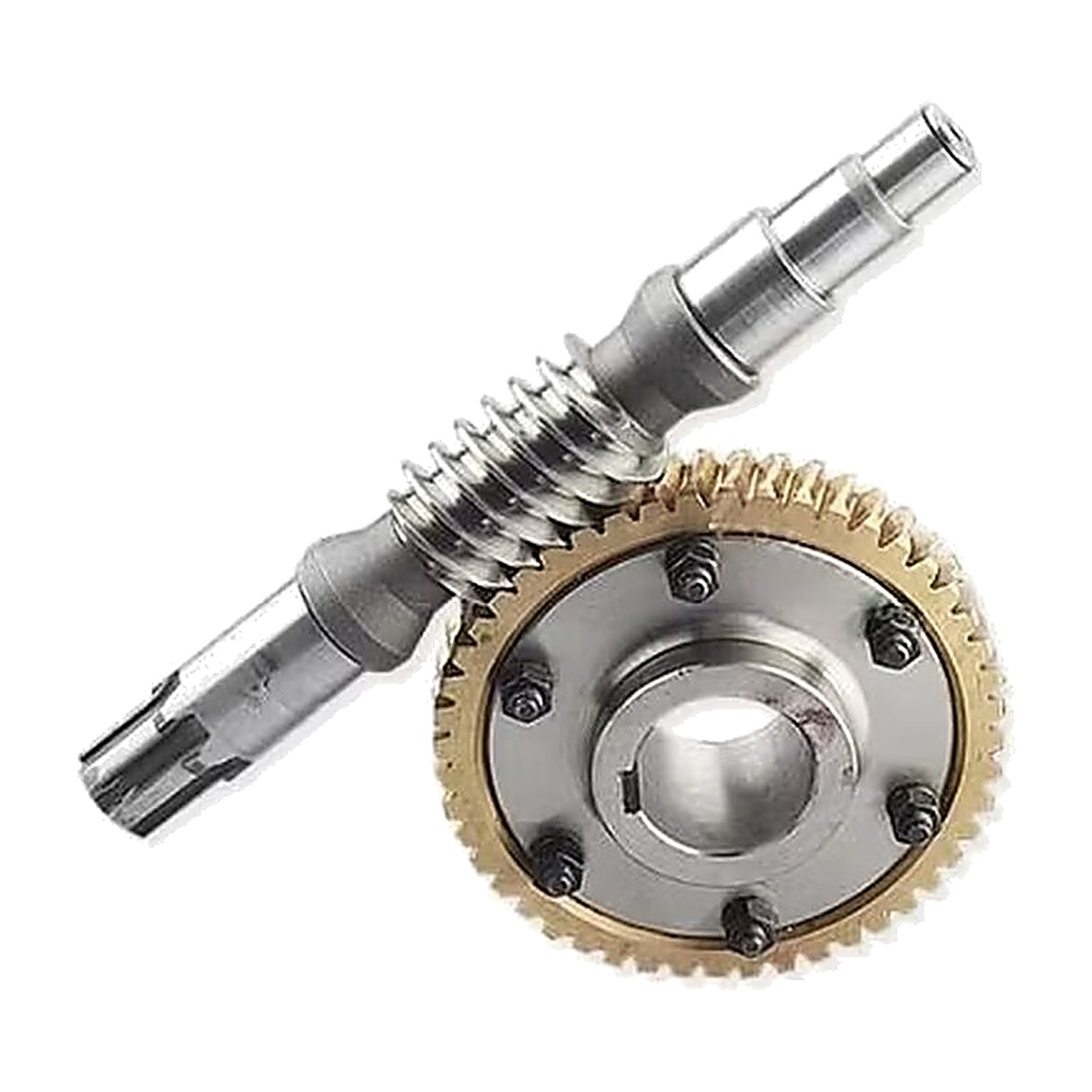
- Worm shaft and bronze worm wheel pairs
- External and internal ring gears
- Spur gear stages
- Matched contact pattern on the bench
Interface
- Motor flange machined to your motor drawing
- Custom spline and key input
- Encoder mounting
- Cable gland orientation
Gear pair
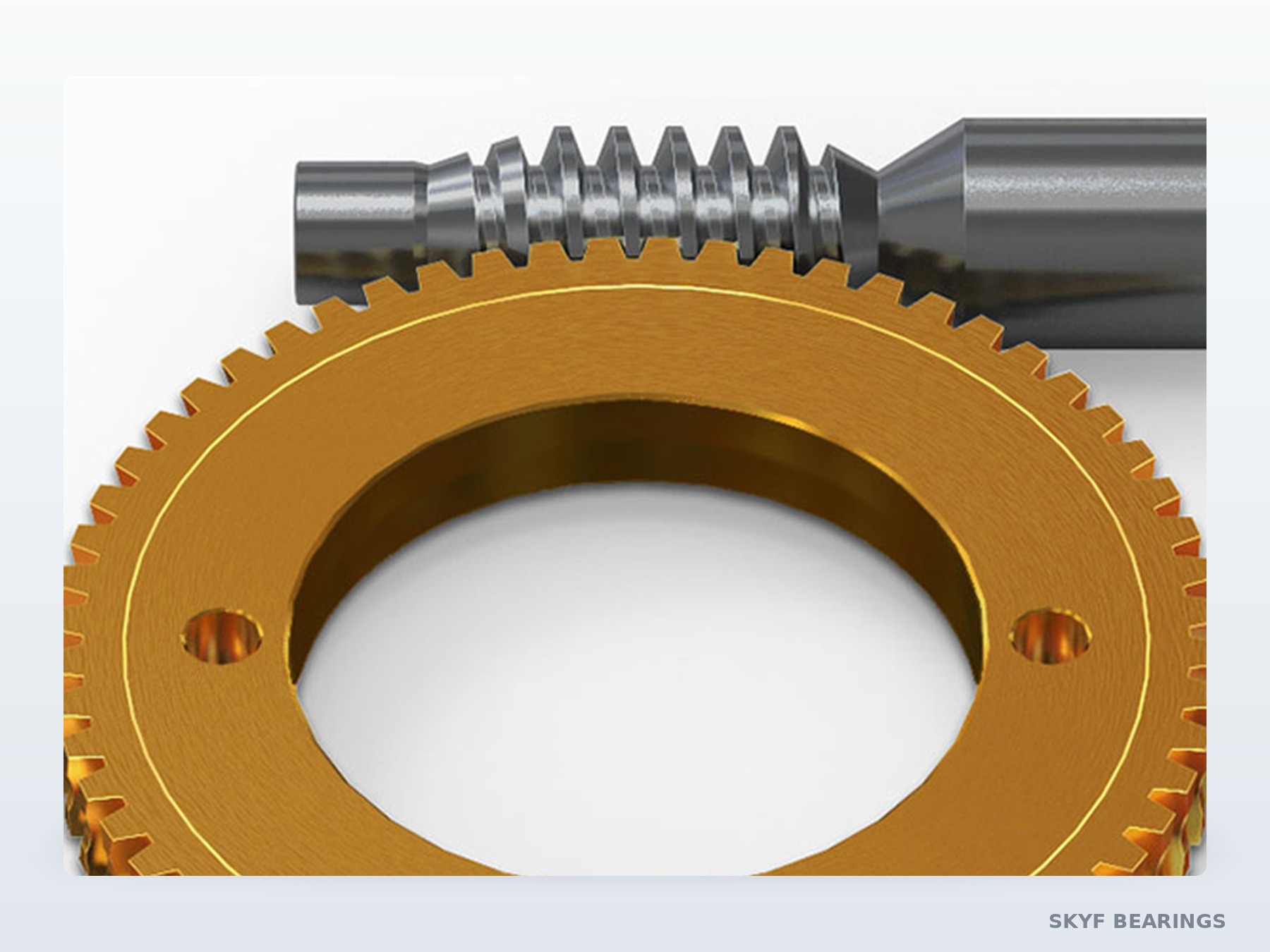
Worm gear pairs as spare parts
For drives already in service, the worm wheel wears before the ring does. We supply matched worm shaft and wheel pairs so you can rebuild a drive instead of replacing it.
- Matched contact pattern checked on the bench
- Same ratio and centre distance as the original
- Material certificate with each pair
How a reverse-engineered part gets approved
01
Send the part
The old ring, a 3D scan, or photos with key dimensions.
02
Rebuild the model
2D drawing and 3D model sent back for your approval.
03
Approve
No production starts until you sign off the drawing.
04
Machine & inspect
First article with a dimensional report.
05
Ship
Seaworthy packing and full documents.
Custom gearing guide
Worm wheels, ring gears, bearing rings and complete assemblies made to a drawing or rebuilt from a worn part. This guide covers what can be specified, what to send, and how a reverse-engineered part gets approved.
What is a custom gear part?
A custom gear part is a toothed or ring-shaped component machined to a drawing rather than selected from a catalogue: a worm wheel, a worm shaft, a ring gear, a bearing ring, or a complete sub-assembly built around them. The drawing defines the geometry; the material, heat treatment, tolerance and inspection level are agreed with it.
This is the normal route in two situations. The first is a machine that is out of production — the original part number no longer exists, but the gearbox still has to run. The second is a new machine where the geometry is set by the structure, not by a catalogue, and the gear has to fit the space that is left.
What separates a custom part from a stock one is not only the shape. It is that the tooth geometry, the bore fit, the keyway and the mounting face are all defined together, so the part arrives ready to assemble instead of ready to adapt.
Types of custom gear parts
- Worm gear pairs — wheel and shaft cut as a matched pair, so the lead angle, centre distance and backlash are correct before assembly. Supplied as spares for gearboxes where the pair has worn.
- Ring gears — external or internal teeth on a large ring, hardened and ground where the duty requires it, with the bolt pattern cut to the mating structure.
- Spur and helical gears — single gears or small sets, cut to module and tooth count, with the bore, keyway and hub detail to drawing.
- Bearing rings — inner or outer rings for slewing bearings, including raceway grinding and gear cutting on the same part.
- Complete assemblies — ring, pinion, housing and seal built and tested as one unit where the customer does not want to assemble.
- Reverse-engineered replacements — a worn or broken part rebuilt into a model, approved, then machined to the approved drawing.
- Obsolete equipment parts — where no drawing exists and the geometry has to be recovered from the part itself.
Features of custom gear parts
- One piece accepted — a single replacement part is a normal order, not an exception. Tooling is only discussed where the geometry genuinely requires it.
- Reverse engineering — where the drawing is missing, the part is measured, modelled and sent for approval before any material is cut.
- Material choice — 42CrMo4, 50Mn, 20CrMnTi for case-hardened gears, bronze for worm wheels, selected against load rather than habit.
- Matched pairs — worm and wheel cut together so contact pattern and backlash are set at the factory, not on the machine.
- Hardening and grinding — induction hardening for raceways and large teeth, case hardening and grinding for small precise gears.
- Inspection records — tooth thickness, backlash, runout, hardness and, where required, a contact pattern record.
- Drawing discipline — the approved model becomes the reference for future orders, so a second batch matches the first without re-measuring.
Applications of custom gear parts
- Replacement of obsolete parts — machines still in service whose original manufacturer has stopped supporting them.
- Gearbox repair — worn worm pairs and ring gears replaced as a matched set rather than one half of the mesh.
- OEM development — new machines where the gear geometry is fixed by the structure and no catalogue part fits.
- Retrofit and upgrade — an existing machine given a higher ratio, a different mounting pattern or a harder tooth surface.
- MRO and spare parts stock — a small batch held for a critical machine where a line stoppage is expensive.
- Reduction of supplier dependence — a part re-sourced from a drawing that the customer owns.
- Prototyping — one-off gears for a test rig, before the design is frozen.
Custom gear parts for sale
Every order starts from information rather than from a part number. The path is the same whether you have a full drawing or only a broken part in a bag.
Price depends on size, material, tooth geometry, whether hardening and grinding are needed, the tolerance class, the inspection level and the quantity. A single worm wheel and a batch of fifty are different economic propositions because setup dominates the first and material dominates the second.
Minimum order. One piece. A reverse-engineered replacement is priced and accepted at quantity one.
Lead time. Quoted per part, separated into modelling and approval time, material lead time, and machining time — because on a one-off part the modelling step is real work and pretending otherwise only hides it.
Send what you have: a drawing, a photo with a scale, the key dimensions, the mating part, or the worn part itself. Something is always enough to start.
Custom gear parts buying guide
What you send decides how quickly and how accurately the part comes back. The list below is ordered by how much difference each item makes.
- The part, or a good drawing. A drawing with tooth data is fastest. A worn part is second best — wear can be measured and compensated. A photo alone works only for simple geometry.
- Tooth data. Module, number of teeth, pressure angle, helix angle where relevant, and the mating gear’s tooth count. For a worm pair: number of worm starts, lead angle and centre distance.
- Material and heat treatment. What the original was, or what the load requires. If the original failed by wear, a harder surface may be the fix; if it failed by fracture, hardness is the wrong lever.
- Tolerance class. Bore fit, keyway width and tooth thickness tolerance. These decide whether the part presses on without shimming.
- Quantity and repeatability. State whether this is a one-off or the first of a series; a repeat order will be machined to the approved model, so it pays to get that model right.
- Inspection requirement. A dimensional report, a hardness report, or a third-party inspection. Ask for it at quotation stage, not after machining.
- Interfaces. Keyway, spline, taper, threaded holes, dowel holes and the mounting face that has to mate with the existing housing.
Working principle of a custom gear pair
Two gears transmit rotation because their tooth profiles are conjugate: as the driving tooth pushes the driven tooth, the contact point moves along a path that keeps the angular velocity ratio constant. For involute teeth that path is a straight line, which is why involute gearing runs smoothly across a range of centre distances instead of only at one exact spacing.
The ratio is set by tooth count. A 60-tooth wheel driven by a 2-start worm advances one tooth per worm revolution, so sixty worm turns produce one wheel turn — a 60:1 reduction from geometry alone. A spur pair reaches its ratio from the ratio of the two tooth counts in the same way.
Two properties matter when a part is being made rather than bought. Backlash is the gap between meshing teeth, and it is set by tooth thickness: too little and the mesh binds and heats, too much and the axis rocks. Contact pattern is where the load actually sits across the tooth face; a pattern concentrated at one end means the axes are misaligned or the teeth are cut with a lead error, and the part will fail at that end regardless of material.
That is the reason a custom pair is cut and checked together. Geometry that is correct on each drawing can still be wrong in mesh.
How does custom machining work?
Once a drawing is approved, the part follows a fixed route. Knowing the route explains the lead time and where a change still costs nothing.
- Material. Bar, forging or ring roll depending on size, with the certificate held against the order.
- Rough machining. Turning the blank to leave stock for heat treatment distortion.
- Gear cutting. Hobbing for most gears, shaping for internal teeth and for shoulders that block a hob, and thread milling for worms.
- Heat treatment. Induction hardening for large teeth and raceways, case hardening for small precise gears. Distortion allowance is built into the previous step, which is why the roughing stock matters.
- Grinding. Bore, faces and, where specified, tooth flanks. Ground flanks are what allow a tight backlash and quiet running.
- Matching. For a pair, the wheel is checked against the worm or pinion on a centre- distance fixture, and the contact pattern is read before the part is released.
- Inspection and marking. Dimensions, backlash, hardness, then part number and heat number marked on the part.
A change to the bore or keyway is cheap before heat treatment and expensive after grinding. A change to the tooth count after cutting means a new blank. Getting the approval right at the model stage is what keeps both costs off the order.
Customize your gear part
- Geometry — module, tooth count, pressure angle, helix angle, profile shift, crowning where misalignment is expected.
- Material — carbon steel, alloy steel for hardening, bronze or cast iron for worm wheels depending on load and speed.
- Heat treatment — induction, case, through hardening or none, with the hardness range stated.
- Bore and interface — plain bore, keyway, spline, taper, threaded holes, dowel holes, pilot diameter.
- Tolerance — bore fit, keyway width, tooth thickness, runout and face parallelism, called out per feature rather than as a general note.
- Surface — phosphating, black oxide, painting or bare, with masked areas where paint would change a fit.
- Marking — part number, heat number, orientation mark and customer-specific identification.
- Documentation — dimensional report, hardness report, contact pattern record, material certificate.
Custom gear parts packaging & shipping
- Tooth protection — each gear is wrapped individually; teeth never rest on a hard surface, because a single bruise becomes a noise source in the mesh.
- Pair packing — a matched worm and wheel ship together, labelled as a pair, so they are not separated in the customer’s stores.
- Rust prevention — VCI film and desiccant for machined and ground surfaces, with oil film where the part will be stored for a long period.
- Carton or crate — cartons for small gears, wooden crates for ring gears and assemblies, with internal blocking so parts cannot collide.
- Labelling — part number, quantity and heat number on the outside of every package, matched to the packing list.
- Terms — EXW, FOB or CIF; courier for small urgent parts, air or sea for volume. Insurance on request.
For spare-parts stock we can pack to your stores reference and include the approved drawing number on the label, so a part ordered three years later matches the one already on the shelf.
Custom gear parts manufacturer
Making a part to a drawing is a machining job. Making a part that fits a machine whose drawing no longer exists is a different job, and it needs both the measuring capability and the willingness to stop and ask before cutting.
The route is: measure or receive the geometry → build the model → send it for approval → agree material and heat treatment → machine → inspect → pack against the approved drawing number.
Two habits make the difference on repeat orders. The approved model is kept, so the second batch is machined to the same reference instead of being re-measured from a worn sample. And the inspection record is kept against the heat number, so if a part is ever questioned, the actual measurements are available rather than a recollection.
This is also why single pieces are accepted. A customer with a stopped machine cannot wait for a batch threshold, and a part made once correctly is the best possible reference for the next one.
FAQ of custom gear parts
I only have the broken part, no drawing. Can you still make it?
Yes. Send the part or clear photos with a scale and the key dimensions. We measure it, build a model, and send the model for approval before machining. Where the part is worn, we measure the unworn sections and reconstruct the original geometry.
What is the minimum order?
One piece. Reverse-engineered replacements are routinely accepted at quantity one.
Can you improve a part that keeps failing?
Often yes, but the failure mode has to be identified first. Wear points to hardness or lubrication; fracture points to material or geometry; pitting points to contact stress. Increasing hardness on a part that failed by fracture makes it worse.
Do you supply worm and wheel as a matched pair?
Yes, and it is recommended. A new wheel run against a worn worm, or the reverse, gives a poor contact pattern and a short life. The pair is cut and checked together.
What tolerance can you hold on the bore and keyway?
It is stated on the drawing per feature — typically a press or transition fit on the bore and a controlled width on the keyway. Send the mating shaft dimensions if the fit is critical, rather than leaving it to a general tolerance block.
Will a repeat order match the first batch?
Yes, because the second order is machined to the approved model and drawing number, not re-measured from a sample. Keep the drawing number on the label and the match is traceable.
Can you supply the complete assembly instead of loose parts?
Yes — ring, pinion, housing and seal assembled and tested as one unit, where the customer does not want to set backlash and contact pattern on site.
Send photos and key dimensions
Even without a drawing, a few photos with the outside diameter, bore and height are usually enough for us to come back with a proposal.