
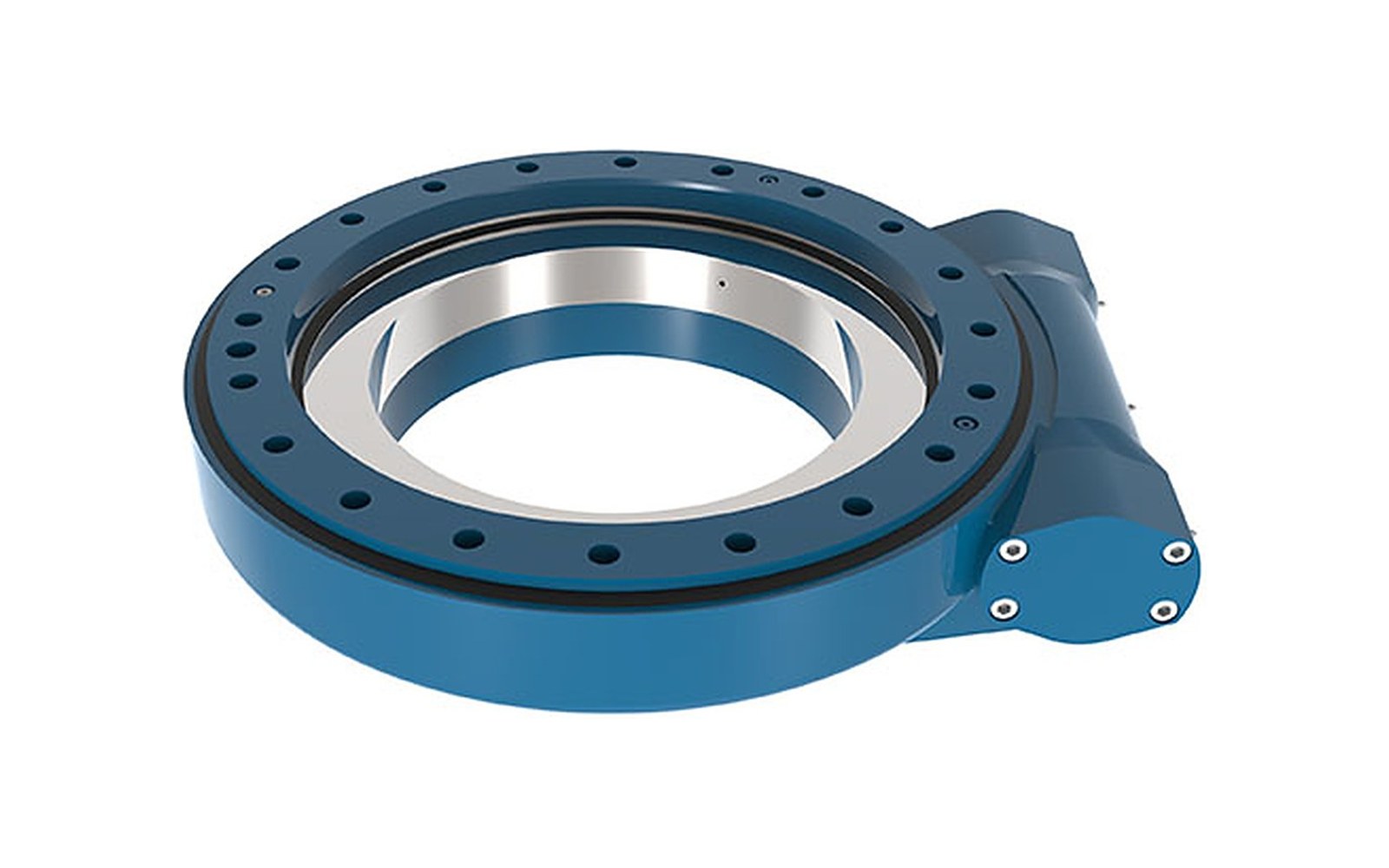
What is a slewing bearing?
A slewing bearing — also called a turntable bearing or swing circle — is a large-diameter rolling bearing (also written slewing ring) that lets two parts of a machine rotate relative to each other while carrying load in three directions at the same time: axial load, radial load and tilting moment.
A slewing ring is the same part under its older name, and the two terms are used interchangeably in drawings and purchase orders.
That combination is what separates it from an ordinary bearing. A standard ball bearing is built to carry load in one direction and is mounted in a housing that takes care of the rest. A slewing bearing has no housing. The mounting bolt circle is the housing, the gear teeth may be cut into the ring itself, and the whole assembly is often a structural member of the machine — an excavator swing circle, a crane slew ring, the rotation joint under a solar tracker.
Most rings are supplied as two machined rings with a row of balls or rollers between them, a seal on each side, grease nipples, and a gear cut on the outside or inside diameter. Outside diameters in our range run from 100 mm to 6 m, and everything above that is quoted individually.
Types of slewing bearing
Seven structures cover almost every enquiry we receive. The differences are the number of raceways, the rolling element, and therefore the capacity-to-height ratio. The seven are listed below, starting with the four-point contact ball ring that most swing circles use and finishing with the geared and flanged variants.
| Structure | Load path | Typical strength |
|---|---|---|
| Crossed roller | Cylindrical rollers crossed at 90 degrees in one raceway | High stiffness, minimal deflection |
| Double row ball | Two ball rows with separate raceways | Higher tilting capacity than single row |
| Three-row roller (13 series) | Two axial raceways plus one radial raceway | Highest capacity we make |
| External gear | Any of the above with teeth on the outer diameter | Pinion can sit anywhere on the perimeter |
| Internal gear | Any of the above with teeth in the bore | Mesh protected inside the structure |
| Flanged / light series | Integral flange, or a thin reduced section | Fewer parts, or lower weight |
Gearing is not a separate structure — it is applied on top of one. Any ring can be supplied plain, with external teeth, or with internal teeth. The same applies to hardening: raceways are induction hardened as standard, and the hardened depth is quoted per application rather than taken from a catalogue table.
Features of a slewing bearing
- Three loads through one joint. Axial, radial and moment capacity are quoted together, because a ring that is strong axially but weak in moment will still fail on a cantilevered boom.
- The ring is the structure. Bolt circles, counterbores, grease passages and gear teeth are all machined into the ring, so the machine has one part fewer and one joint fewer than a bearing-plus-housing design.
- Induction hardened raceways. 42CrMo4 or 50Mn rings, raceway hardness typically 55–62 HRC, with the soft zone — the unhardened strip left where the filling plug goes — positioned away from the loaded arc.
- Sealing quoted explicitly. Double-lip NBR as standard, Viton for high temperature. The seal, not the steel, is usually what ends a ring’s life in the field.
- Clearance and preload set to the drawing. Normal, reduced or preloaded, because a positioning axis and a swing circle need different answers from the same ring.
Applications of slewing bearings
| Machine | Why a slewing ring fits |
|---|---|
| Solar trackers | Slow rotation, long life, low starting torque |
| Port and shipyard cranes, stacker-reclaimers | Continuous rotation under heavy axial load; fatigue life governs, not static capacity |
| Machine tools, rotary tables, positioners | Position has to be held; crossed roller rings are chosen for stiffness |
| Ladle turrets, converters | Heat-stabilised rings, high-temperature grease, thermal growth designed in |
Size is only half the decision. The same 1,000 mm ring can be right for a crane and wrong for an excavator, because the duty cycle, the shock load and the environment decide the structure, the hardening depth and the sealing.
Working principle of a slewing bearing
The ring carries load through a single closed raceway. In a four-point contact ring the raceway is ground to a Gothic arch, so one ball touches it at four points: two on the outer ring, two on the inner ring. Axial load in either direction, radial load and tilting moment all resolve into those four contact points, which is why the structure can be so thin.
Rotate the ring and the balls roll along the raceway, separated by a cage or spacer that keeps them evenly spaced. Grease sits in the raceway groove and is pushed around by the balls themselves, which is why a correctly filled ring can run for long intervals without re-lubrication — and why an over-greased ring can blow a seal.
The gear, when fitted, is a separate load path: a pinion meshes with the teeth on the ring and drives rotation. The bearing carries the load, the gear carries the torque, and the two are machined in the same setup so the pitch circle runs true to the raceway.
How does a slewing bearing work in a machine?
Mounting is where most rings are lost. The flange the ring bolts to has to be flat and stiff enough that it does not deflect under load and concentrate the load on part of the raceway. Bolts have to be preloaded to the figure on the drawing, not torqued to feel. Water has to drain away from the seal, not into it.
The crossed roller structure is the more forgiving choice when the flange cannot be made stiff enough, because each roller contacts along its full length instead of at four points.
Get those three right and the ring runs for years with an annual grease check. Get them wrong and the raceway spalls in a season, which is why we ask for the mounting flatness and bolt class with every enquiry rather than after the first failure.
Slewing bearings for sale
Rings are quoted per drawing. Send the outside diameter, bore, raceway centre diameter, section height, hole pattern, gear module and tooth count, plus the axial, radial and moment figures. If the drawing does not exist yet, send the machine, the load and the rotation and we will propose a structure and a size.
Standard sizes are kept in stock for the common four-point contact and three-row roller ranges; anything outside those is machined to order, typically four to six weeks for a first article.
Slewing bearing buying guide
1. Start from the moment, not the diameter. Tilting moment usually decides the structure; the diameter then follows from the mounting space. 2. Check the available section height. If the design is height-limited, four-point contact or crossed roller; if capacity-limited, three-row roller. 3. Decide the gear before the drawing is frozen. Internal, external or plain changes the ring, the pinion position and the guard. 4. Specify the environment. Salt air, abrasive dust and radiant heat each change the seal, the grease and sometimes the material. 5. Ask for the inspection record. Raceway hardness, hardened depth, clearance and gear backlash should arrive as measured values with a batch reference. 6. Price the mounting, not just the ring. A cheaper ring on a machined adapter plate can cost more than a flanged ring that bolts straight on.
Slewing bearing customization
Everything that is not a standard size is machined to drawing: non-standard bolt patterns, split rings for structures that cannot be threaded over a shaft, special grease nipple positions, tapped holes in the flange face, phosphate or painted finish, and gear teeth cut to a mating pinion sample.
We machine the mounting flange and the raceway in the same setup, so runout on the flange face stays inside 0.05 mm. Drawings in PDF, DWG or STEP are all workable.
Slewing bearing packaging and shipping
Rings up to about 1.2 m ship in a plywood case with the ring bolted to a pallet base so it cannot rock in transit. Larger rings are crated upright with the raceway face protected and lifting points marked. Every case carries the inspection record, the packing list and a grease specification sheet.
Sea freight is standard for export; air freight is used for urgent spares and for rings small enough to travel as air cargo. We photograph the packing before the case is closed so the condition on arrival can be checked against it.
Slewing bearing manufacturer
Rings are machined, hardened, ground and assembled in one plant, which is what makes it possible to quote the hardened depth and the clearance with the batch reference attached. Heat treatment is induction hardening in-house, followed by tempering and a hardness check on every batch rather than a sample.
The range covers outside diameters from 100 mm to 6 m across the seven structures, with gearing, sealing and clearance selected per application. Custom and reverse-engineered rings — matched to an old part number with no drawing available — are a regular part of the work.
FAQ
How do I choose between a slewing bearing and a plain turntable?
If the joint has to carry load in three directions and hold position, a rolling ring is the lower-friction, longer-life answer. A plain bearing only makes sense for very slow, lightly loaded rotation where cost dominates.
Can a slewing bearing be repaired?
Raceways cannot be re-ground in the field. A ring that has spalled is replaced. What can be done is to re-seal and re-grease a ring that is still sound, which is worth doing on large rings where replacement means lifting the structure.
What is the smallest ring you make?
The light series starts at 100 mm outside diameter with a 20 mm section; below that a crossed roller instrument bearing is usually the better answer.
How long does a ring last?
It depends on the load spectrum and the sealing. A well-sealed ring at rated load typically reaches tens of thousands of hours of rotation; a ring running in abrasive dust with a damaged seal can fail in a single season.
Do you supply the pinion as well?
Yes. Sending the ring drawing with the pinion sample or the gear data lets us match the backlash and the tooth hardness together.
Send the ring drawing, or the load case if there is no drawing yet.
Send your drawing