
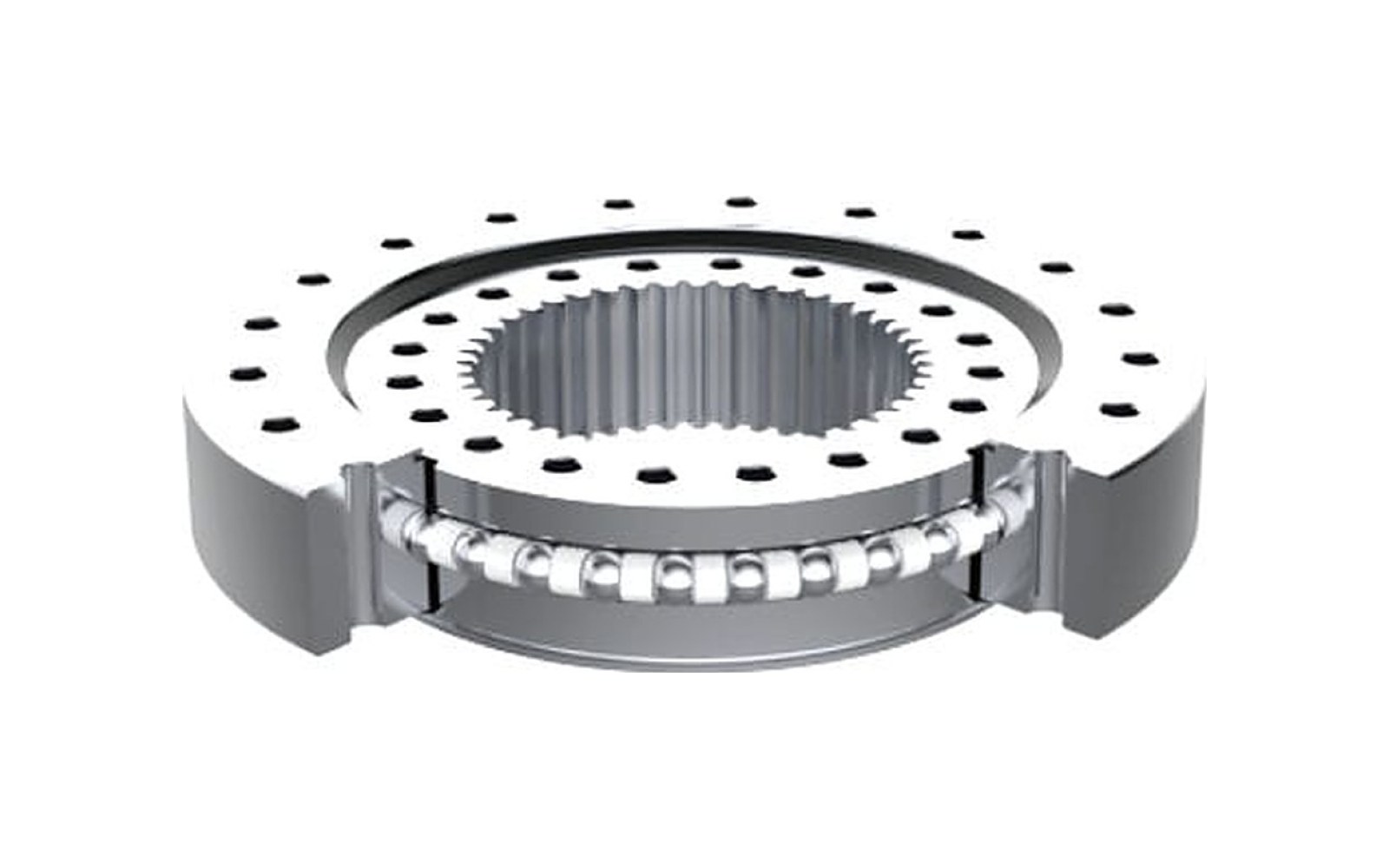
A slewing bearing is often described by its gear: internal, external or ungeared. The choice is usually made early and then constrains everything downstream.
External gear
Teeth on the outside of the outer ring. The pinion sits outside the bearing envelope, which makes it easy to service and easy to retrofit. The trade-off is a larger swept envelope — the drive train sticks out and needs guarding.
Internal gear
Teeth on the inside of the outer ring. The pinion sits inside the bore, so the assembly is more compact and better protected. It is the common choice for excavators and cranes where the drive must not be exposed. Mounting and shimming are more awkward because the pinion is harder to reach.
No gear
An ungeared bearing is used when rotation comes from somewhere else — a separate drive, a hydraulic motor on a chain, or when the ring is structural only. It is the cheapest option and often the right one.
What we need to quote a geared ring
- Module, number of teeth and pressure angle, or the centre distance and pinion data.
- Required backlash and whether the pinion is supplied by you or by us.
- Hardness requirement on the teeth.
Module, teeth and backlash are enough to start.
Send the gear data