
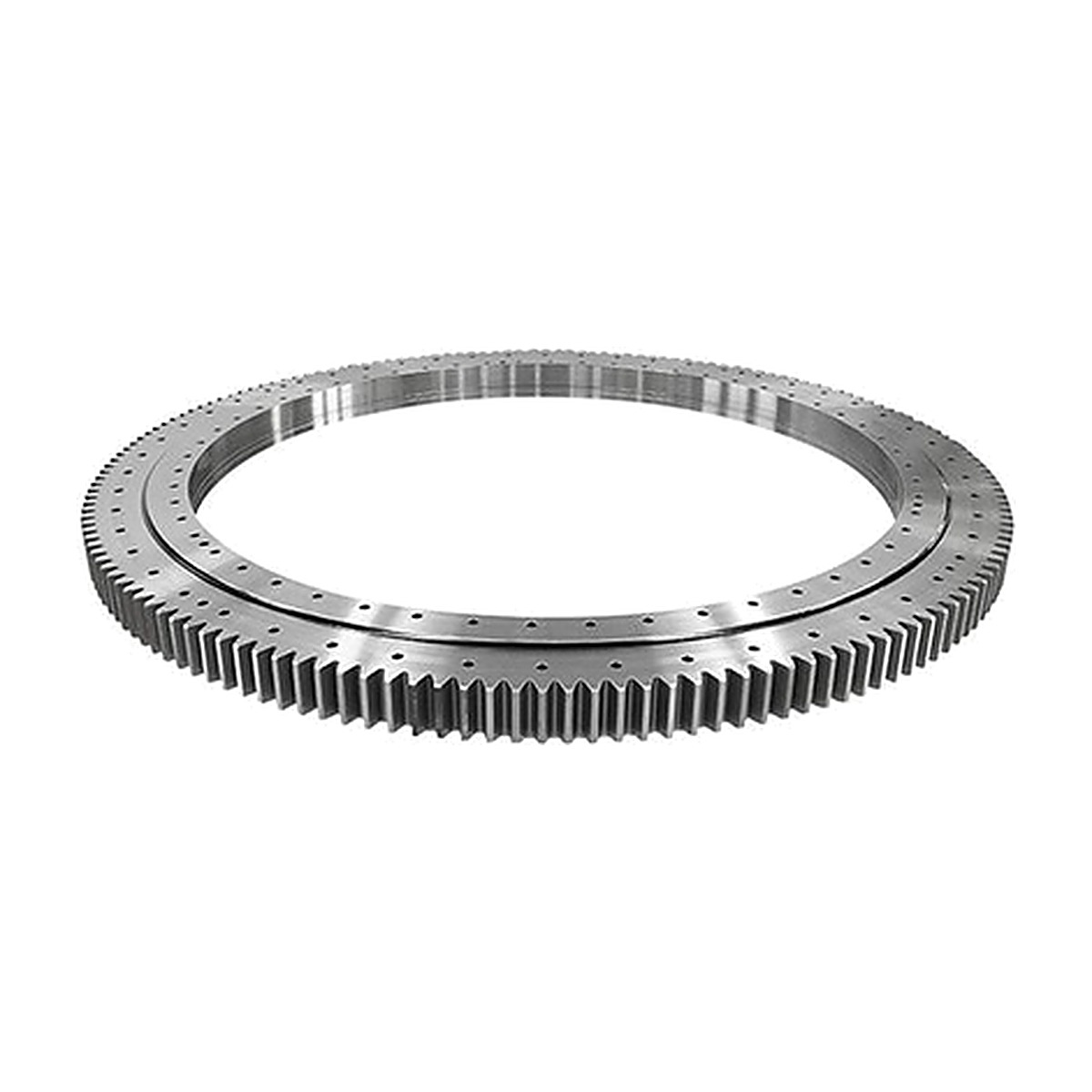
These two structures are the most common source of confusion in a first enquiry, because both are described as handling combined loads. They do — but not equally well, and not at the same cost.
Four-point contact ball
A single row of balls contacts a Gothic-arch raceway at four points, so one bearing takes axial load in both directions, radial load and tilting moment. It is the thinnest option, the cheapest per unit of diameter, and the usual choice for solar trackers, small cranes and light turntables.
- Best for: moderate loads, tight height, cost-sensitive projects.
- Watch out for: it is more sensitive to mounting flange stiffness than a roller bearing. A thin, flexible flange will deflect and load only part of the raceway.
Crossed cylindrical roller
Cylindrical rollers sit at 90° to each other in a single raceway, so the contact is line contact rather than point contact. Stiffness is higher and the bearing tolerates heavier and more eccentric loads, at the cost of a taller section.
- Best for: heavy axial or moment load, machine tools, positioners where deflection matters.
- Watch out for: cost, and a taller stack height that may not fit an existing design.
A quick rule
If height is the binding constraint and the load is moderate, take four-point contact. If deflection under load is what you are trying to control, take crossed roller — and expect to pay for it.
Give us the axial, radial and moment figures and we will tell you which structure fits.
Send your load case